All photos by Paige Donner copyright 2015
- Château Margaux, Premier Grand Cru Classé à Margaux, Médoc, classement de 1855 photo copyright Paige Donner 2015
I'll close with a quote from Oscar Wilde, that great lover of our wines, who remarked quite rightly: "The French are so proud of their wine that they have even named some cities after their great growths." From Bordeaux to Margaux, he couldn't have put it better…

- Philippe Castéja
President , Conseil des Grands Crus Classés en 1855 Médoc & Sauternes
- Château Margaux, Premier Grand Cru Classé à Margaux, Médoc, classement de 1855 photo copyright Paige Donner 2015

SPEECH by Philippe Castéja June 15, 2015
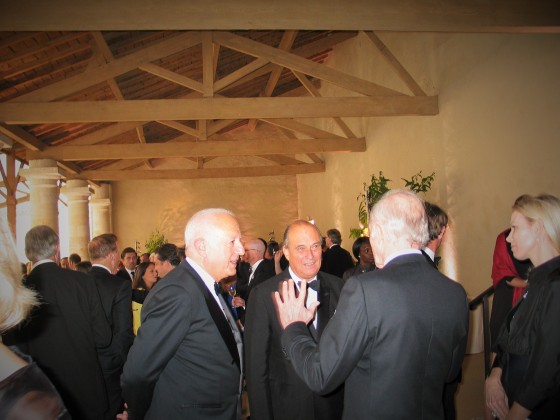
Once again Margaux welcomes us for a dinner that has become a tradition; a tradition of meeting with you, our friends of the international press, to exchange views on numerous subjects of current importance in conversation with the many proprietors who have come to join you at this event tonight.
I thank you, dear Corinne [mentzelopoulos], for your renewed and constant support, even while your team at Margaux has been occupied these past months with the work leading to the completion of the excellent facilities you have unveiled to us this evening.
This work reminds me of something that President John Kennedy once said:
"The art of success consists of knowing how to surround yourself with the best."
Accordingly, you have selected Lord Norman Foster for your architect, and Paul Pontallier and your entire team for the rest. This evening, you have privileged us all with the opportunity to be here...
Permit me to comment briefly on the activity of our Council during these recent months. Our participation in the week celebrating the "Taste of France" was noteworthy. At the Château de Versailles close to 800 people were in attendance, while some 15,000 restaurateurs participated in their kitchens around the world. And another prestigious location, the Quai d'Orsay, saw the presentation of the new book on the 1855 Classed Growths, published by Glenat on the occasion of the classification's 160th anniversary. 1855 to 2015 is 160 years—a ripe and opportune age for this Classification to be celebrated on April 18th in the presence of his excellency, the Minister of Foreign Affairs Laurent Fabius. I'd like to cite his words here, since his remarks were so exact:
"Beyond questions of personal taste, wine is a very serious matter for our country because it is an important part of French identity, and the names of the great classed growths are part of our cultural heritage. They are renowned throughout the world and play an important role in bringing visitors from across the globe to France."
Thus, after decades characterized by the establishment of regulations without equal in other wine producing countries, a French minister gives wine its proper recognition as a part of culture and savoir-vivre; as an incontestable and essential element of France's heritage.
We can only rejoice in this acknowledgment which is so unlike the official discourse which wanders between moral hygienics and a type of wine-bashing which France (with its Loi Evin, in particular) does so well.
At a time when incontestable efforts are being made to revitalize our economy, the recognition—at long last—of the positive impact on our country's international image by French winemaking and its most renowned representatives fills us with satisfaction. I would add that the presence of the
President of the French Republic at Vinexpo gives added confirmation of the interest among public authorities for our efforts. Because the vitality of this classification remains unquestioned despite the changing nature of our
world, the time is right to secure its inclusion in the repertoire of intangible elements of French cultural heritage, a first step to its international recognition by UNESCO.
Everyone knows the basic details of the classification's genesis set in a given time and place, but from these origins it has evolved to become an authoritative reference, a spur to greater quality and a source of inspiration, but without hindering a spirit of healthy competition and the creation of magnificent wines, both here and around the world.
The 1855 classification belongs to the winemaking world; it is a shared heritage which symbolizes the quest for excellence which inspires all great winemakers everywhere. The 1855 classification does not automatically confer economic advantage, but rather imposes a constant obligation in the name of an ancient principle: noblesse oblige.
Tonight, on the opening of this year's Vinexpo, the Great Classed Growths of 1855 are pleased to share with you this moment of happiness. You represent the media of 37 different nationalities, with a shared and singular interest in wine.
This is what the city of Bordeaux has sought to make manifest in its support for the construction of the Cité des Civilisations du Vin, in concert with the Aquitaine region and the wine world's many benefactors. I highly recommend that you visit the site in the coming days. With this building's striking architectural statement set along the river's edge, Bordeaux sends the world a message of friendship imbued with a proud, long history. But tonight, I'll close with a quote from Oscar Wilde, that great lover of our wines, who remarked
quite rightly: "The French are so proud of their wine that they have even named some cities after their great growths." From Bordeaux to Margaux, he couldn't have put it better…
I wish you all an enjoyable dinner, an enchanted stay in our vineyards, and I'm sure that your palate's pleasure this evening will serve to inspire your imaginations.
Philippe Castéja
President
Conseil des Grands Crus Classés en 1855 Médoc & Sauternes
FOLLOW US ON TUMBLR * FOLLOW US ON TWITTER * LIKE US ON FACEBOOK